Austria Via Ferrata: Routes, Grades and What to Expect
Austria's via ferrata routes range from beginner cable-protected climbs to exposed high-mountain traverses. Here is how grades, gear and access work.
On this page
Austria's via ferrata are protected climbing routes where steel cables, rungs and ladders turn steep rock into a climbable line without a rope team. They sit between hiking and climbing: you move on rock, but your security comes from clipping into fixed hardware rather than from a partner's belay. That makes them a good fit for fit hikers with a head for exposure who want more than a summit path, and a poor fit for anyone hoping for a walk in the woods.
What a Via Ferrata Is and How Austrian Routes Are Protected
A via ferrata is a climbing route equipped with steel fixtures — cables, rungs, staples and ladders — bolted to the rock so that climbers can move upward while attached to the mountain. The hardware is the protection, and on most routes it runs in continuous stretches rather than covering every metre of rock between them.
The practical consequence is that a ferrata is not a climb where the mountain catches you. The cable stops a fall only if you are clipped in with a proper via ferrata set, and short unprotected passages between cable sections still demand sure feet and hands. Treat the protected sections as the hard parts you prepare for, not as a safety net that removes the need for balance and route-reading.
Austrian routes range from short, low-grade climbs above valley villages to long high-mountain lines with sustained exposure. Some are reached straight from a road or lift station; others begin after a proper hiking approach, which is why fitness and navigation matter as much as climbing confidence. If you are still choosing where to base yourself in the country, the wider hiking in Austria guide covers the main mountain regions and valleys.
Via Ferrata Grades and What Each Grade Asks of You
Austrian ferrata are graded on a scale from A, the easiest, up through B, C, D and E to F for the hardest. The grades describe the technical demands of the protected climbing: how vertical the rock is, how small the holds, how much you rely on arm strength rather than footholds, and how much exposure the line carries.
A and B routes suit confident hikers trying a ferrata for the first time: the climbing is mostly easy scrambling with cables for security, and the rock is rarely vertical for long. C routes are where genuine climbing begins, with steeper steps and more sustained cable sections. D, E and F lines are for experienced ferrata climbers with strong arms and a settled head for heights.
Read the grade alongside the approach and the descent. A B-rated route with a two-hour hike in and a long scree descent is a bigger day than a short C route beside a lift, and the grade alone will not tell you that. Match the whole day to your fitness, not just the climbing pitch.
Donnerkogel Via Ferrata Above Gosau: The Sky Ladder Route
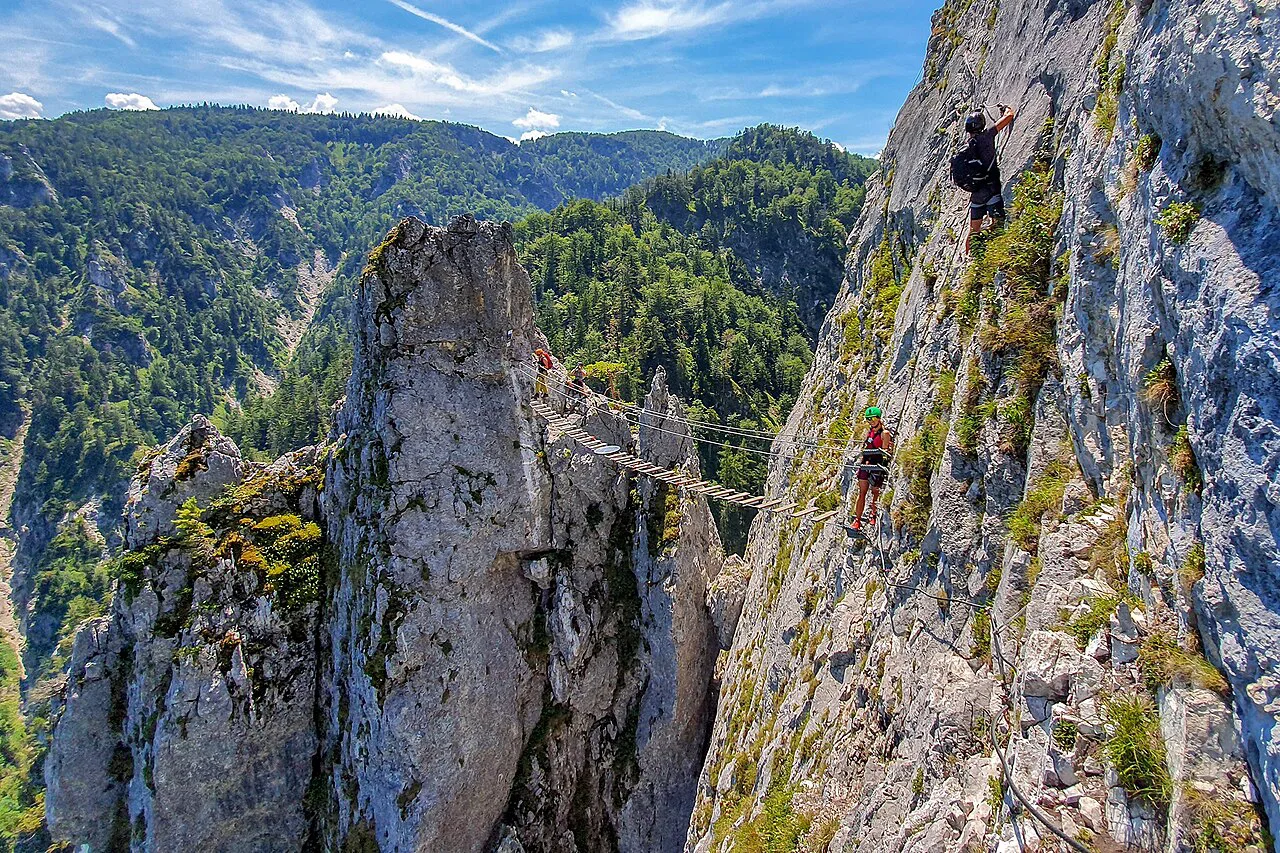
The Donnerkogel via ferrata above Gosau in Upper Austria is the country's best-known protected climb, largely because of its Sky Ladder — a ladder section suspended across exposed rock that has become the route's signature image. It sits in the Dachstein Salzkammergut area, above the Gosau valley, and is offered commercially as a guided day out by local mountain guides.
The route is rated difficult in the guiding listings, which places it well beyond a first ferrata. The exposure on the ladder and the sustained climbing mean you should arrive with ferrata experience, a head for heights and the fitness to keep moving on steep ground for hours. This is not a route to learn clipping technique on.
If you want the guided version, Bergführer Büro Salzburg runs the Donnerkogel Sky Ladder as a guided ferrata from Gosau, listed for climbers aged 14 and over and advertised with free cancellation. That format supplies the guide, the local route knowledge and the pacing decisions on the day. Book through the Bergführer Büro Salzburg listing online ahead of your preferred date.
The Dachstein Salzkammergut is also classic hiking country, so a ferrata day can sit inside a longer walking trip. If that is your plan, the hiking in Austria guide is the place to start shaping the rest of the itinerary around Gosau.
Access, Lifts and Approach to the Donnerkogel Route
The Donnerkogel ferrata starts above Gosau, and the usual approach is on foot from the valley, often combined with a lift to shorten the climb. The route is reached via the Dachstein Salzkammergut lift system on the Gosaukamm side, and guided parties meet in Gosau before heading up as a group.
Lift operating seasons and first-and-last ascent times change with the year, so check the lift operator's own page for the dates of your trip before you build a plan around riding up. Outside the lift season the approach is entirely on foot and the day gets considerably longer. Guided bookings confirm the meeting point and start time directly.
Allow for the descent as well as the climb. The route is commonly done as an out-and-back, and the return leg on steep ground is where tired legs cause problems. Start early enough that you are off the exposed rock before the afternoon builds.
Distance, Ascent and Walking Time on the Donnerkogel
The Donnerkogel Klettersteig is mapped as a 5.8-mile (about 9.3 km) out-and-back route from the Gosau side, and it is rated as a challenging outing. That figure covers the full walk rather than the protected climbing alone, so the cable sections are only part of the day's effort.
The guided version is scheduled as a 5 hour 30 minute day, which is a realistic window for the climb, the ladder and the return when a guide sets the pace. Self-guided parties should plan on at least that, and more if the approach is on foot without a lift.
Ascent figures vary with the line taken and whether you use the lift, so work from the mapped distance and your own pace rather than a single number. Build in a buffer for queues at the ladder on busy summer days, which can add real time to the descent.
Drachenwand Via Ferrata Above the Mondsee Valley
The Drachenwand is the limestone wall rising above the Mondsee valley in the Salzkammergut, near St. Lorenz, and its via ferrata is the second route offered by Bergführer Büro Salzburg in the region. The guided version is listed as a moderate, four-hour outing suitable from age 14, which makes it the more accessible of the two commercially guided ferrata in these listings.
Moderate here means a step down from the Donnerkogel rather than a beginner's route: expect cable-protected climbing on steep limestone with sustained exposure above the valley. It suits hikers with some scrambling behind them who want a first guided ferrata with a proper summit feel. The shorter day also leaves room to walk in the Mondsee area afterwards.
The wall is steep and largely south-facing, so it dries quickly after rain but heats up in high summer. Carry water for the climb and start in the morning. Guided places are booked through Bergführer Büro Salzburg, and the meeting arrangements for St. Lorenz are confirmed when you book.
Guided Versus Self-Guided: Which Format Suits Which Hiker
Self-guided ferrata suits climbers who already own a via ferrata set and helmet, have practised clipping and moving on cable, and can read a route description and judge weather for themselves. Austria's protected routes are open to anyone properly equipped, and many experienced climbers simply go. The trade-off is that every decision — route choice, turn-around time, retreat — is yours.
Guided ferrata suits three groups: first-timers who want to learn the system on real terrain, hikers without the technical gear, and anyone tackling a hard route like the Donnerkogel Sky Ladder who would rather have local knowledge on the ladder. The listed guided offers include the guide and the day's logistics; check what equipment is included when you book.
A middle path is to hire a guide for one day to learn the ropework and clipping, then climb easier routes independently afterwards. That gets you the skills without committing every ferrata day to a paid format. If you prefer your mountain days organized end to end, the Austria walking holidays section covers guided and self-guided formats for walkers.
Gear: Harness, Via Ferrata Set, Helmet, Gloves and Footwear
The non-negotiable kit is a climbing harness, a via ferrata set — the energy-absorbing lanyard system with two arms that clip into the cable — and a climbing helmet. The set is what makes a cable fall survivable, so a improvised sling or a single carabiner is not a substitute.
Add gloves with grip and some leather on the palm, because hot cables and rough rock wear through bare hands on long routes. Approach shoes or stiffer hiking boots with a defined edge work for easier ferrata; harder routes reward a proper climbing shoe or a boot designed for via ferrata, where edging on small holds matters.
Carry a small pack with water, a shell, a warm layer and a headlamp, and keep it close to your back so it does not swing on the climb. If you are buying your first set, get it fitted at a mountain shop and practise clipping and unclipping at ground level before the route.
Scrambling, Exposure and Weather on Austrian Ferrata
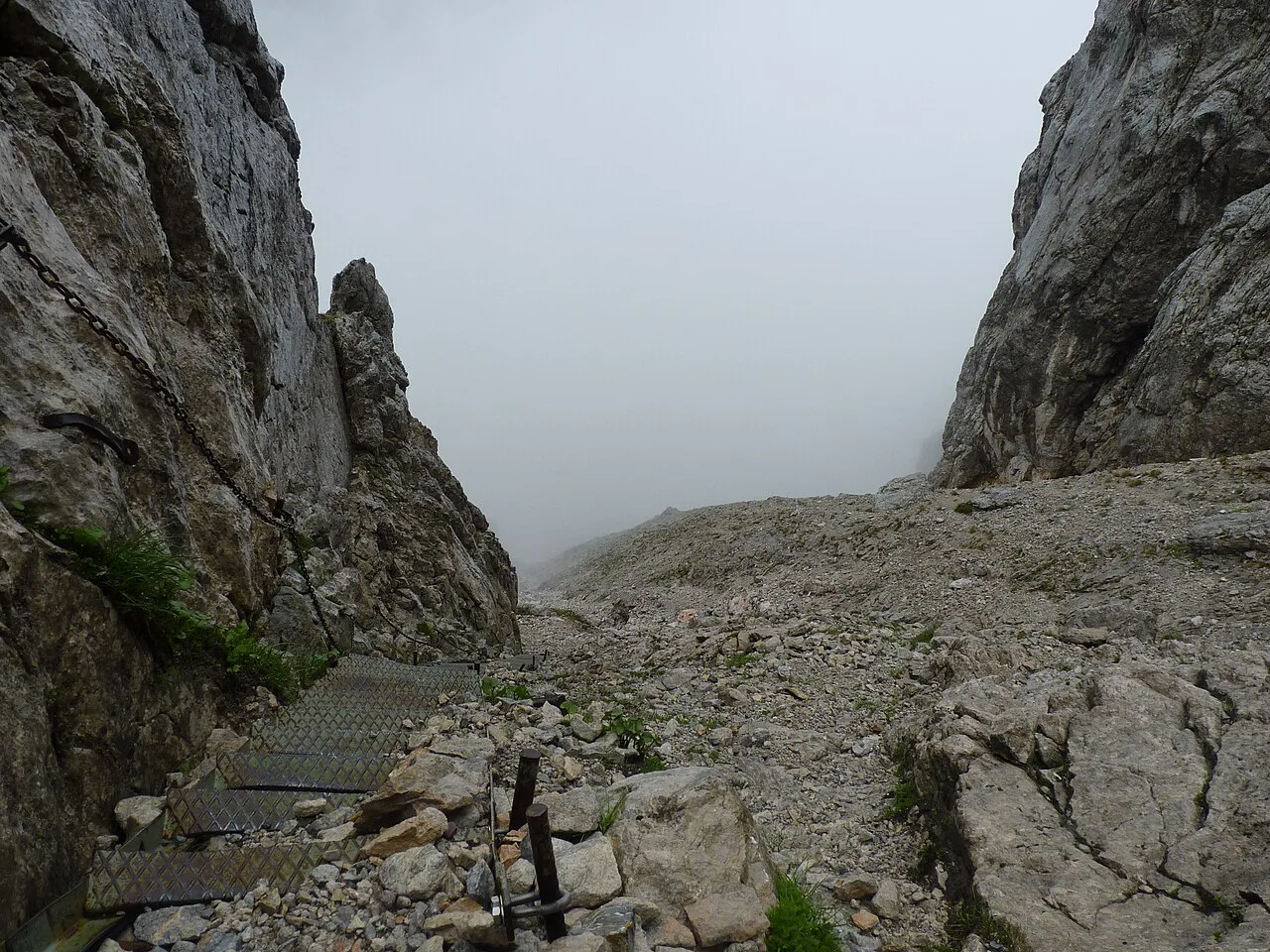
The real hazards on Austrian ferrata are simple and consistent: long unprotected stretches of scrambling where a slip has consequences, sustained exposure that unsettles people who are fine on marked trails, and rockfall from parties above you. Clip in as soon as the cable starts, keep three points of contact on unprotected rock, and wear a helmet throughout, not just on the climbing.
Weather drives the day. Afternoon thunderstorms are a regular summer pattern in the Alps, and being on a steel cable on an exposed ridge when lightning arrives is a serious position. Start early, watch the sky, and be willing to turn around before the climbing gets good if the forecast is building. Snow lingers on north-facing approaches and upper sections into early summer and returns in autumn, so a route can be dry in the valley and wintry up top.
Rockfall is the other risk, particularly on popular routes with parties moving above each other. Keep your spacing, avoid knocking stones loose, and do not stop directly beneath another group on a steep section.
When to Go: Season, Snow and Afternoon Storms
The reliable window for Austrian ferrata runs from early summer, once snow has cleared from approaches and upper rock, through to early autumn. Mid-summer gives the longest days and the driest rock but also the busiest routes and the highest chance of afternoon storms. Late summer and early autumn often bring the best combination of dry rock, settled weather and thinner crowds.
Late spring and late autumn are shoulder seasons: the climbing can be excellent on a warm day, but snow can sit on shaded approaches and the upper sections, and some lift systems run reduced services outside the main season. Check the lift company's published dates before relying on a ride up, and be ready to walk in.
On any day, the shape of the day matters more than the month. Start early, aim to be off the exposed climbing by early afternoon, and treat a forecast of thunderstorms as a reason to choose a shorter, lower route rather than to go anyway.
Huts and Overnight Options Near Via Ferrata Routes
The Donnerkogel and Drachenwand are commonly done as day routes from valley bases rather than as hut nights. Gosau and the Mondsee valley both work as bases, with the ferrata approached on foot or by lift and the evening spent back down in the valley. Staying locally shortens the morning and gives you a weather buffer.
If you want to combine a ferrata with a multi-day mountain itinerary, Austria has a strong hut network on its long-distance routes. The hut to hut hiking Austria guide covers how the huts work, and the Adlerweg (Eagle Walk) through the Tyrol is the classic long route for walkers who want mountain nights between stages.
For a high-alpine loop with optional ferrata terrain nearby, the Berliner Höhenweg in the Zillertal Alps is another well-known Austrian circuit with hut stays. Both are separate trips from a single ferrata day, but they show how a ferrata can slot into a larger Austrian mountain plan.
Guided Costs and Booking a Via Ferrata Day
Guided ferrata in Austria are sold as day packages, and the listed prices vary with the route and the provider. Bergführer Büro Salzburg lists the Donnerkogel Sky Ladder guided ferrata from 580 EUR and the Drachenwand guided ferrata from 540 EUR, both with free cancellation and both for climbers aged 14 and over. Those are Bergführer Büro Salzburg's listed starting prices, not a market rate, and they move with dates and group arrangements. Check current prices before booking.
Self-guided climbing costs you the gear and the lift ticket, not a guide fee. If you need to rent a via ferrata set and helmet, mountain shops and guiding offices in the Salzkammergut rent equipment, and the rental terms are set locally rather than nationally.
When booking a guided day, confirm what is included — gear, lift ticket, transport to the trailhead — and where the group meets. Those details decide whether you need to arrange your own transport to Gosau or St. Lorenz, and they are confirmed with the booking rather than in the listing headline.
Plan Your Austrian Via Ferrata
Pick the route to fit the day you actually have: the Drachenwand for a shorter moderate outing above the Mondsee valley, the Donnerkogel Sky Ladder for a hard, exposed classic that rewards experience. Sort out gear first, decide guided or self-guided second, and build the plan around an early start.
Then widen the trip. Austria's ferrata sit inside a strong hiking country, and the hiking in Austria guide shows how to pair a climbing day with valley walks around Gosau and the Salzkammergut. For a city-based alternative, the Innsbruck via ferrata above the Nordkette shows how the same protected-climbing day can start from an urban lift.
Frequently Asked Questions
What is a via ferrata and how is it different from a hike?
A via ferrata is a climbing route protected with fixed steel cables, rungs and ladders that you clip into with a dedicated lanyard set. You move on rock rather than a trail, so it demands climbing confidence, a head for exposure and a via ferrata set, helmet and harness; a marked hiking path does not.
What grade is the Donnerkogel Sky Ladder via ferrata?
The guided listings describe the Donnerkogel Sky Ladder as a difficult route, excluding young or inexperienced climbers and setting an age minimum of 14 for the guided format. Take that as a difficulty rating rather than a technical grade, and arrive with ferrata experience before attempting the exposure on the ladder. Check current details before booking.
How long does the Donnerkogel via ferrata take?
The guided Donnerkogel Sky Ladder day is listed as 5 hours 30 minutes from Gosau, which covers the approach, the protected climbing and the return. Self-guided parties should budget at least that, and more if they walk the whole approach instead of using a lift.
Do you need a guide for a via ferrata in Austria?
Many experienced climbers do Austrian ferrata self-guided with their own gear, and the routes are open to properly equipped climbers. A guide makes sense for first-timers learning the clipping system, hikers without equipment, or anyone tackling hard exposed lines such as the Donnerkogel Sky Ladder.
What gear do you need for an Austrian via ferrata?
You need a climbing harness, a via ferrata set with energy-absorbing lanyards, and a helmet, plus gloves and footwear with a defined edge for small holds. Carry water, a shell and a warm layer in a close-fitting pack, and practise clipping before you start.
When is the best time to do a via ferrata in Austria?
Early summer through early autumn gives the most reliable conditions, once snow has cleared from the approaches and upper rock. Mid-summer brings the longest days but also the busiest routes and the highest chance of afternoon storms, so start early and plan to be off exposed ground by early afternoon.
Sources
Trail notes for your next trip
Optional updates when we add or revise hiking guides.
You might also like
Continue reading
More guides you'll find useful