Scotland Via Ferrata: The Two Protected Routes and What They Involve
Scotland has two protected climbing routes: the guided via ferrata at Kinlochleven and the free Elie Chainwalk in Fife. Here is how each one works.
On this page
Scotland's protected climbing is short, specific and unlike the bolted iron roads of the Alps. You have two options: a guided via ferrata in the Highland village of Kinlochleven, and the Elie Chainwalk in Fife, a free chain traverse under basalt cliffs that you manage entirely yourself. Both are half-day outings, and both reward planning rather than pure nerve.
They differ in almost everything else. One needs a booking, a guide and a harness system; the other needs grippy shoes, a tide table and a head for heights. Pick according to your appetite for exposure, your tolerance for cold water and spray, and whether you want a mountain day wrapped around the protected section or a coastal one.
What a via ferrata is and how Scotland's two routes differ
A via ferrata is a protected climbing route fitted with fixed metal aids, usually climbed with a harness and a energy-absorbing lanyard clipped to a cable. Scotland has no bolted alpine iron road of that kind in general use. What it does have is one guided route built beside a waterfall, and one chain traverse on the coast that functions as an assisted scramble.
The guided route at Kinlochleven uses professional equipment and a certified guide, and Explore-Share describes it as Scotland's only via ferrata. The Elie Chainwalk requires no harness or rope at all, just hands on eight metal chains above rocky bays. That single difference, staying clipped in on a guided line or managing chains yourself, is the decision that shapes your day.
Kinlochleven Via Ferrata: setting beside Scotland's second-highest waterfall
The route climbs alongside the Grey Mare's Tail, Scotland's second-highest waterfall, in a bedrock amphitheatre above Kinlochleven. The village sits at the head of Loch Leven in the Western Scottish Highlands, less than an hour south of Fort William. Views open over the water and back down to the village from the route.
Kinlochleven's other advantage is position. It lies at the western end of the West Highland Way, so you can pair the via ferrata with a few days of long-distance walking into Fort William, or use the village as a base while the walkers in your group finish the route.
Kinlochleven Via Ferrata: route length and what the half-day involves
The protected route covers about 500 m around the amphitheatre, joining climbing on the rock with wire bridges and zip lines above the gorge. Operators run it as a half-day trip, so expect a few hours on the route including the briefing and equipment fitting. No prior via ferrata experience is required, but a fair level of physical fitness is.
That format suits groups with mixed ambitions. You get the exposure and the waterfall in a short block of time, without committing a whole day or carrying your own rack up a mountain. The trade-off is a set pace and a set line rather than a route you can read and choose on the day.
Kinlochleven Via Ferrata: meeting point, season and who it suits
The meeting point is Kinlochleven itself, which keeps logistics simple if you are staying in the village or driving down from Fort William. Trips run from May to October, so the route is a summer and early-autumn option rather than a winter outing.
The minimum age is eight, and anyone under 18 must be accompanied by an adult, so families with older children can plan it in. Complete beginners are accepted, which makes it a sensible first taste of protected terrain before you commit to an alpine trip.
Kinlochleven Via Ferrata: gear, guiding and booking
Book through a certified mountain guide, and expect the guiding fee to cover instruction. The route is run with state-of-the-art via ferrata kit, and Explore-Share lists a guiding fee among the price inclusions, so check exactly what is covered and whether you need to bring your own footwear when you reserve.
If you have climbed indoors or scrambled in summer boots but never clipped into a cable, this is the gentlest introduction in the country. If you already climb and want a harder protected line, Scotland will feel limited; plan a trip to the Honister Slate Mine in England if you want a longer, mine-based course.
Elie Chainwalk: the free chain traverse on the Fife coast
The Elie Chainwalk is a traverse across the foot of soaring basalt cliffs on Fife's south coast, near the village of Earlsferry. Eight metal chains are fixed across rock faces of up to 10 vertical metres, and you move between them over rocky bays. It is free, unguided and open to anyone prepared for it.
Unlike a continental via ferrata, you do not clip in. There is no cable, no lanyard and no harness requirement; the chains are handholds and footholds, not protection. That makes the chainwalk closer to a coastal scramble than to alpine protected climbing, and it means self-reliance matters more.
Elie Chainwalk: start point and the approach over Kincraig Hill
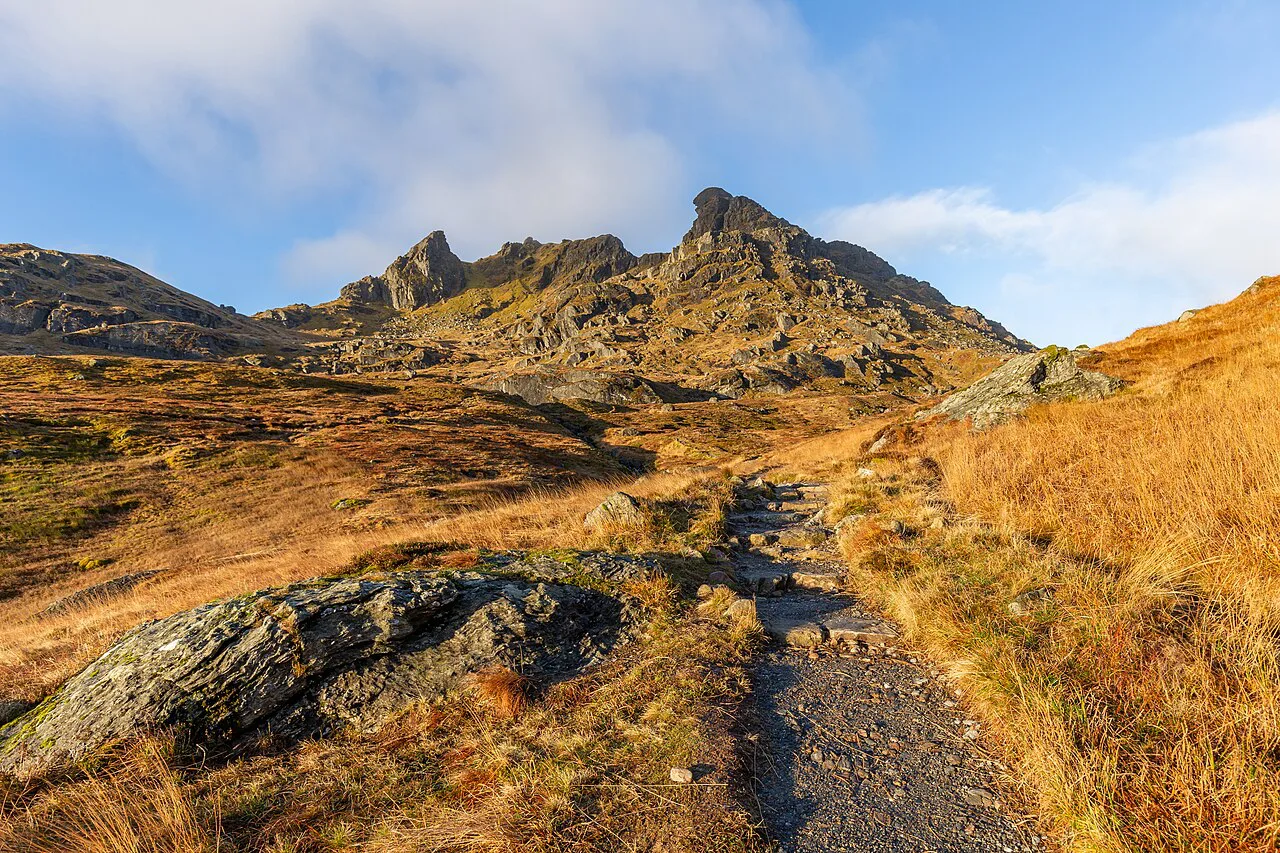
Start and finish on Chapel Green Road at the west end of Earlsferry, where there is street parking. Buses serve Earlsferry, so the walk works without a car. From the village, a path leads via Earlsferry West Beach and up onto Kincraig Hill, a low summit of 63 m that gives you the coastal view before the scrambling starts.
The approach over the hill is the scenic way in and also the gentler one. It puts the harder, more exposed sections late in the walk, when you have warmed up and read the rock. Dropping straight to the chains from the village skips that build-up.
Elie Chainwalk: distance, ascent and walking time
Allow 5 km (3 mi), 130 m of ascent and 2 to 3 hours for the full figure-of-eight circuit. That is short enough for a half-day, but the scrambling and the waits at the chains make it slower than the distance suggests. The path sections are clear, sandy beach on the outward leg and rough ground near the descent into the chainwalk.
Most of the climb is on Kincraig Hill rather than on the chains themselves. The chainwalk section is a descent and traverse with scrambling rather than a long ascent, so the day is more about steady hands than big legs. Sturdy footwear matters at the very start.
Elie Chainwalk: the chain sections, exposure and scrambling
The chainwalk is technically fairly easy but significantly exposed, with the sea and rocks below you for much of the traverse. The rock is rough on the hands, so grippy gloves make it more comfortable. Helmets are advisable, though many people walk it without one.
Proper footwear is essential and a head for heights is the real entry requirement. If the exposure feels beyond you, the sensible response is to backtrack and take the cliff-top path rather than push on. The chain sections can be left at several points, which makes turning around a realistic option.
Elie Chainwalk: tides, footwear and direction
Parts of the chainwalk are flooded at high water, for up to two hours either side of the tide. Plan the traverse around low water and treat the tide window as the day's fixed appointment. A rising tide on the rocks is the main hazard on the route, so check tide times before you leave Earlsferry.
Walking it west to east, from Earlsferry, eases you in with the trickier spots left towards the end. Walking east to west is possible but harder, because the harder ground comes first. Choose west to east for a first attempt and take the scenic approach over the hill.
Getting to Kinlochleven and Earlsferry without a car
For the guided route, the practical base is Fort William, from which Kinlochleven is less than an hour south by road. Fort William also has the rail station and bus links that make it the transport hub for the West Highlands. Follow Explore-Share's meeting instructions when you book.
For the chainwalk, buses run to Earlsferry, so the Fife coast is reachable by public transport. The walk is point-to-point in the sense that you start and finish at the same place, which keeps the return simple. Street parking at the west end of Earlsferry is the fallback for drivers.
Which route suits your fitness, head for heights and budget
If you want a guided, gear-supplied introduction to protected climbing and a waterfall as the backdrop, Kinlochleven is the fit; it asks for fitness and accepts beginners and children from eight. If you want a free coastal scramble you can do at short notice, the Elie Chainwalk suits you, provided you can manage exposure over the sea and time your crossing with the tide.
If you have a head for heights but not for cold water, the chainwalk is the better first outing, because you can turn back at any chain section. If you have neither, stay on the cliff-top path and enjoy the coast. If you want mountain rather than coast, spend the day on the West Highland Way instead.
Nearby scrambling and gorge walks that are not via ferratas
The Grey Mare's Tail canyon and the Inchree Falls canyon near Fort William are separate activities, involving abseils and jumps rather than chains or clips. Inchree Falls canyon is a three-hour trip for ages eight and up, and Vertical Descents makes every feature optional, so it can be gentle or full-on. It is not a via ferrata and is not a substitute for one. Check current prices and dates before booking.
If you are bagging summits while in the Highlands, pursue the Munros rather than looking for protected routes; the sport in Scotland is big mountain days on foot, not iron roads. Around Fort William, Ben Nevis is the obvious high ground. Both need boots and weather sense, not a lanyard.
What to wear and carry on a Scottish protected route
On Kinlochleven, bring firm footwear, a spare layer and a towel for after the waterfall; the guide supplies the via ferrata equipment. On the chainwalk, bring grippy footwear, gloves for the rust and rough rock, and a waterproof in one small pack.
Even on a short route, carry water, a warm layer and a basic first-aid kit. In the Highlands, the weather can turn on Kincraig Hill and in the amphitheatre alike; on the coast, spray and tide decide more than wind does. The day is short enough that a small pack is enough on both routes.
Plan Your Visit
Choose your route by what you want to feel: a guided waterfall climb with a booking and a guide, or a free chain traverse you manage yourself against the tide. Both are good days; they just ask different things of you. Build the rest of your Highland or Fife plans around one of them and you will have a clear, well-paced outing.
If you go, keep the day simple: check the tide window at Earlsferry, confirm the meeting point at Kinlochleven when you book, and carry footwear you can scramble in. That is all either route needs to turn into one of the better half-days of a Scottish trip.
Frequently Asked Questions
Is there a via ferrata in Scotland?
Scotland has one guided via ferrata at Kinlochleven, run with a certified guide alongside the Grey Mare's Tail waterfall, and a free chain traverse called the Elie Chainwalk on the Fife coast. The chainwalk uses metal chains but no harness or rope.
Is the Elie Chainwalk free?
Yes. The Elie Chainwalk is a free route on the coast at Earlsferry with eight metal chains fixed across the foot of basalt cliffs. You provide your own footwear and gloves, and you walk it without a guide.
Do you need a guide for the Kinlochleven via ferrata?
The route is offered as a guided half-day trip with a certified mountain guide and equipment provided. Book directly with the operator; the meeting point is Kinlochleven, and trips run from May to October.
Can beginners do a via ferrata?
Both Scottish routes suit beginners. The Kinlochleven trip needs no prior via ferrata experience but a fair level of fitness, and the minimum age is eight. The Elie Chainwalk needs a head for heights, grippy footwear and an eye on the tide.
How long is the Elie Chainwalk?
The full circuit is 5 km (3 mi) with about 130 m of ascent, taking 2 to 3 hours. It combines a beach approach, a climb over Kincraig Hill and the chain traverse itself.
When can you cross the Elie Chainwalk at high tide?
Parts of the chainwalk are flooded for up to two hours either side of high water, so plan around low water. Check tide times before setting out and start west to east from Earlsferry for the easier progress.
What is the hardest via ferrata in the world?
That question is outside the scope of this guide; Scotland's two protected routes are short and beginner-friendly rather than extreme. For harder protected climbing, plan a trip to an alpine region or to the Honister Slate Mine in England.
Sources
Trail notes for your next trip
Optional updates when we add or revise hiking guides.
You might also like
Continue reading
More guides you'll find useful